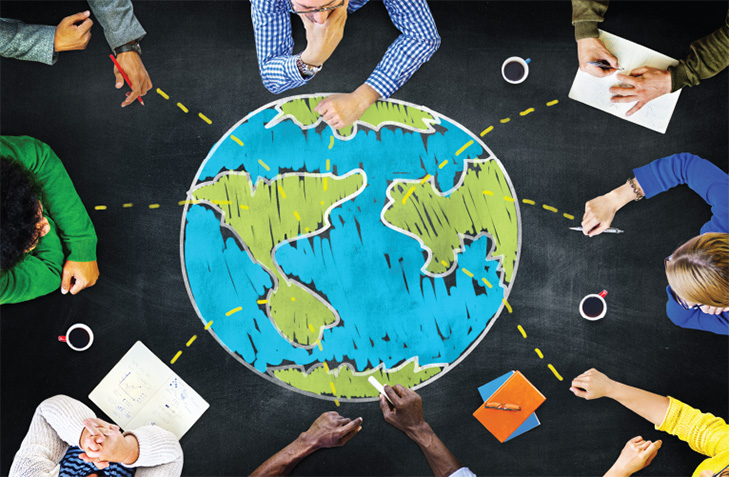
Globalization has become one of the defining forces shaping contemporary societies. It influences economies, cultures, technologies, and patterns of human interaction across borders. Education, as a central institution of social development and knowledge transmission, has not remained untouched by these transformations. The interconnectedness of the modern world has altered what is taught, how learning occurs, and the purposes education is expected to serve. Understanding how globalization influences education requires examining not only technological and economic shifts but also deeper cultural and intellectual changes.
At its most visible level, globalization expands the flow of information. Knowledge once confined to specific regions or institutions now travels instantly across digital networks. Students can access lectures, research, and educational resources produced anywhere in the world. This unprecedented availability reshapes expectations. Learning is no longer restricted by geography, and exposure to diverse perspectives becomes a routine feature of academic life. Educational boundaries that once separated local and global contexts grow increasingly porous.
The circulation of knowledge, however, is not merely a technical phenomenon. It carries cultural implications. Education historically reflected national priorities, languages, and traditions. Globalization introduces a broader spectrum of ideas, values, and intellectual frameworks. Classrooms increasingly engage with international case studies, comparative analyses, and cross-cultural themes. Students encounter perspectives that challenge familiar assumptions, encouraging more expansive modes of thinking. The curriculum itself evolves as global awareness becomes integral to intellectual development.
Language provides a particularly vivid example of globalization’s educational impact. Communication across borders elevates the importance of shared linguistic tools. Proficiency in widely used languages often becomes associated with academic mobility and professional opportunity. At the same time, this shift raises questions about cultural preservation and linguistic diversity. Educational systems must balance the practical advantages of global communication with the need to sustain local identities and traditions. The tension between integration and distinctiveness becomes an enduring feature of policy and pedagogy.
Globalization also reshapes the economic context of education. Labor markets increasingly operate on international scales, and professional competition extends beyond national boundaries. Educational institutions respond by emphasizing skills perceived as globally relevant, such as critical thinking, technological fluency, and collaborative competence. The notion of employability becomes intertwined with global competitiveness. Students are encouraged to view learning not only as personal enrichment but as preparation for participation in dynamic, interconnected economies.
This economic dimension influences institutional priorities. Universities and schools seek to align programs with emerging industries and transnational opportunities. Partnerships between educational organizations and global enterprises become more common. Curricula adapt to reflect technological developments and shifting professional landscapes. While such alignment can enhance relevance, it also prompts reflection on education’s broader purposes. Balancing market responsiveness with intellectual, ethical, and civic development remains a central challenge.
Technological advancement, closely linked to globalization, transforms educational delivery. Digital platforms enable remote instruction, virtual collaboration, and access to global learning communities. Physical classrooms coexist with online environments that connect learners across continents. Educational experiences become increasingly hybrid, blending local engagement with global interaction. This transformation expands opportunity but also exposes disparities in infrastructure, connectivity, and digital literacy. The promise of global access highlights persistent inequalities.
Cultural exchange represents another profound influence. Students and educators encounter ideas, traditions, and worldviews beyond their immediate environments. Exposure to diversity can foster empathy, curiosity, and intellectual openness. It can also generate friction when values, norms, or expectations diverge. Education becomes a site where global and local cultures interact, sometimes harmoniously and sometimes contentiously. Navigating these dynamics requires sensitivity, reflection, and an appreciation for pluralism.
The concept of citizenship itself evolves within this context. Traditional education often emphasized national identity and civic responsibility within defined political boundaries. Globalization introduces the notion of global citizenship, encouraging awareness of shared challenges such as environmental sustainability, technological ethics, and social equity. Educational frameworks increasingly incorporate themes that transcend national concerns, inviting students to consider their roles within broader human communities. This expansion enriches perspective while raising questions about identity and belonging.
Academic mobility further illustrates globalization’s reach. Students pursue opportunities across borders, institutions attract international cohorts, and collaborative research networks span regions. Such mobility fosters intellectual exchange and cross-cultural understanding. It also intensifies competition among institutions seeking global recognition. Rankings, reputation, and international visibility influence strategic decisions. The pursuit of global standing shapes investments, priorities, and organizational identity.
Despite these opportunities, globalization introduces complexities. Standardization of educational models, driven by international benchmarks or policy convergence, can streamline comparability but may overlook contextual diversity. Practices effective in one setting may not translate seamlessly to another. Educational systems differ in cultural assumptions, social structures, and historical trajectories. Preserving local relevance while engaging with global frameworks requires nuanced approaches that resist simplistic uniformity.
Equity remains a critical concern. Globalization can expand access to knowledge and opportunity, yet benefits are unevenly distributed. Economic disparities, technological gaps, and structural inequalities influence who participates fully in global educational networks. Institutions and policymakers confront the challenge of ensuring that globalization enhances rather than exacerbates social divides. Inclusive strategies, infrastructure development, and thoughtful resource allocation become essential.
Globalization also transforms pedagogical philosophy. Knowledge is no longer perceived solely as static content to be transmitted but as dynamic, evolving, and collaborative. Students must learn to navigate information abundance, evaluate credibility, and synthesize diverse inputs. Educators shift from authoritative sources toward facilitators of inquiry and critical engagement. Learning emphasizes adaptability, reflection, and interdisciplinary thinking—capabilities aligned with fluid global environments.
Interdisciplinary education gains renewed importance. Global challenges rarely conform to single disciplines. Climate change, technological governance, public health, and economic development intersect across scientific, social, and ethical dimensions. Educational structures that encourage cross-disciplinary exploration better reflect the complexity of contemporary problems. Students develop integrative thinking, preparing them for contexts where knowledge boundaries blur.
Ethical reasoning becomes increasingly central as global interconnectedness magnifies consequences. Decisions made in one region can influence communities elsewhere. Technological innovations carry transnational implications. Students must grapple with questions of responsibility, fairness, and sustainability within global contexts. Education, therefore, must cultivate not only technical competence but ethical awareness and reflective judgment.
Importantly, globalization does not simply impose external pressures; it also invites reinterpretation of educational identity. Institutions articulate missions that integrate global engagement with local commitment. Educators design experiences that connect universal themes with contextual relevance. Students navigate multiple affiliations, drawing upon diverse cultural and intellectual resources. Education becomes a dynamic dialogue rather than a fixed transmission.
The influence of globalization on education is neither uniformly beneficial nor inherently detrimental. It represents a complex interplay of opportunity, challenge, integration, and differentiation. It expands horizons while demanding adaptability. It fosters exchange while revealing disparities. It encourages innovation while prompting reflection on enduring values
Leave a Reply