For decades, the standard narrative of academic success followed a rigid, predictable path. High school graduates were told that a traditional four-year university degree was the only reliable golden ticket to financial security and professional prestige. Alternative options were often framed as backup plans rather than strategic choices.
That narrative is experiencing a profound shift. The modern academic landscape faces a multi-layered crisis: skyrocketing student debt, an economy altered by rapid automation, and growing public skepticism about the real-world value of a standard humanities or generalized degree. Amid this landscape, community colleges are stepping into a leading role. Once viewed through a lens of unfair stigma, these two-year public institutions are driving the transformation of higher education.
By prioritizing economic agility, pioneering specialized short-term credentials, and offering direct pathways to socioeconomic mobility, community colleges are proving that the future of learning is flexible, localized, and explicitly tied to industry needs.
The Value Paradigm Shift
The modern transformation of higher education is deeply rooted in economics. For generations, families accepted the rising costs of higher education as an unavoidable investment. However, when tuition outpaces median wage growth and graduates find themselves underemployed while carrying massive loan balances, the math stops working.
Public data highlights a distinct divergence in public trust. While overall confidence in traditional four-year institutions has faced steady headwinds, public trust in community colleges has risen significantly, reaching fifty-six percent according to data from research agencies like EAB. The driving force behind this trust is a clear, mathematical value proposition.
Community colleges offer an alternative that largely prevents the systemic accumulation of debt. By keeping tuition rates down—averaging less than one-third of the cost of in-state four-year institutions—two-year colleges allow students to complete their foundational education or technical training without compromising their financial future. The conversation among students and parents is changing from the prestige of the institution to the direct return on investment of the credential.
Redefining the Student Profile
The image of the typical college student—a residential eighteen-year-old taking full-time classes while living on a leafy campus—represents a shrinking minority in higher education. The modern student body is more complex, and community colleges have inherently evolved to support this reality.
Two-year institutions serve a diverse cross-section of society:
- Adult Reskillers: Professionals whose industries have been disrupted by technology and who require rapid, targeted training to pivot into new sectors.
- First-Generation Scholars: Students navigating higher education systems for the first time, balancing familial expectations with economic realities.
- Dual-Enrollment High Schoolers: Younger learners completing college-level credits before even receiving their high school diplomas, a segment that has seen major growth.
- Working Parents: Individuals balancing child care, full-time or part-time employment, and evening or hybrid coursework.
To serve this population, community colleges have abandoned the rigid structures of the traditional academic calendar. They have built an infrastructure around asynchronous online modules, weekend laboratory sessions, and modular schedules that allow students to drop in and out of education as their life circumstances demand. Higher education is transforming from a distinct lifecycle phase into an ongoing, accessible resource.
Short-Term Credentials and the Workforce Alignment
One of the most structural changes community colleges have introduced is the elevation of non-degree programs and industry certificates. For a long time, higher education measured its success almost exclusively by the volume of associate and bachelor’s degrees conferred. Today, the fastest-growing sector of higher ed involves short-term, stackable credentials.
The rise of programs like Workforce Pell underscores this national shift, extending federal grant eligibility to high-demand certificate programs that take less than a year to complete. This model treats education as a collection of specialized building blocks. A student can enroll for six months, earn a certification in advanced welding, cybersecurity operations, or phlebotomy, enter the workforce immediately, and return later to stack those credits toward a full associate degree.
This approach directly addresses the current skills gap in the global economy. Traditional academic structures often require years to approve, design, and launch a new degree program. By the time the first class graduates, the technological landscape has already moved forward. Community colleges operate on a faster timeline, frequently adjusting curriculum based on real-time feedback from local employer advisory boards.
| Attribute | Traditional Four-Year University | Modern Community College |
| Primary Curriculum Driver | Academic theory and comprehensive research | Local labor market demand and applied skills |
| Curriculum Adaptability | Slow, multi-year institutional approval processes | Rapid, semester-by-semester industry updates |
| Financial Entry Barrier | High tuition, frequently requiring long-term debt | Affordable per-credit costs with minimal debt footprint |
| Primary Enrollment Focus | Residential, full-time cohort models | Commuter, hybrid, and part-time flexible options |
Engines of Local Economic Development
Traditional universities often operate as self-contained ecosystems, somewhat insulated from their immediate geographic surroundings. Community colleges, by design, are deeply connected to their local environments. They function as economic engines for their municipal and regional economies.
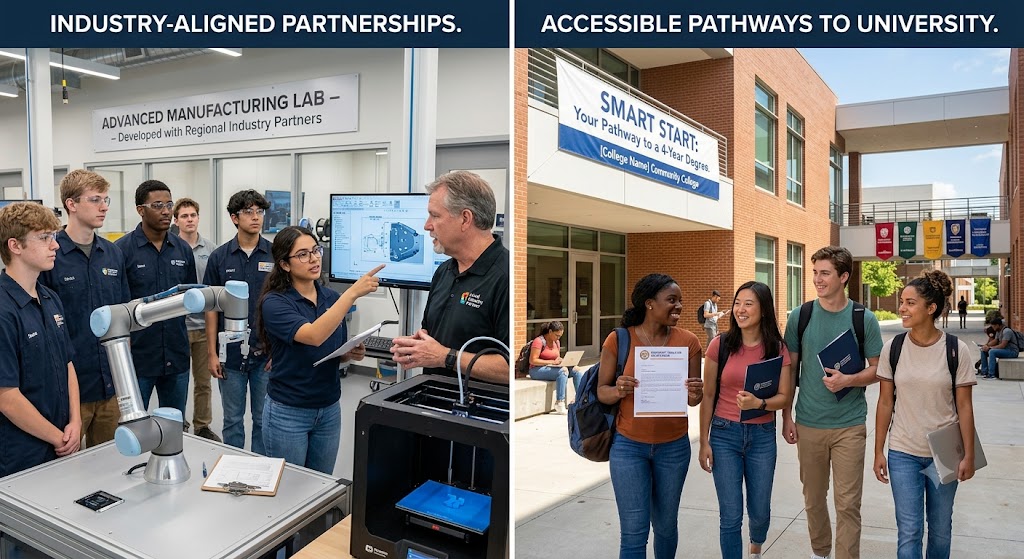
When a major manufacturer relocates to a region, or a healthcare network expands its regional footprint, corporate leaders rarely approach large research universities to build their frontline workforce. Instead, they partner with the local community college. These partnerships result in custom-tailored pipelines where businesses help fund state-of-the-art simulation labs, donate industrial equipment, and guarantee interviews for graduates.
This model provides mutual benefits:
Regional businesses secure a reliable source of job-ready talent trained specifically on their proprietary systems, while students gain direct access to localized employment opportunities without facing a competitive national job market.
This symbiosis turns the community college into a stabilizing force during economic downturns. When regional unemployment rises, these campuses serve as places for rapid retraining, quickly absorbing displaced workers and retooling them for emerging, stable industries nearby.
Democratizing Artificial Intelligence and Technical Innovation
There is a common misconception that cutting-edge technology belongs exclusively to wealthy research institutions. In practice, the democratization of technology like artificial intelligence, advanced robotics, and data analytics is happening across community college networks.
As automation alters entry-level positions across industries, two-year colleges are systematically embedding technical literacy into traditionally non-technical pathways. For example, automotive technology students are working on advanced electric vehicle drivetrains and diagnostics software. Agricultural programs are utilizing drone data analytics for precision farming. Business administration certificates are incorporating practical artificial intelligence prompts and workflow automation tools.
By focusing on the practical application of technology rather than just abstract development, community colleges ensure that first-generation and low-income students are not left behind by technological progress. They bridge the digital divide, providing hands-on access to the tools shaping the modern workplace.
Seamless Pathing and the Hybrid Future
The evolving role of community colleges does not mean the end of the four-year university; rather, it redefines the relationship between them. The growth of comprehensive articulation agreements—formal partnerships ensuring that community college credits transfer seamlessly to public universities—has created a popular, cost-effective hybrid model.
Students can complete their general education requirements at a local community college, benefiting from smaller class sizes and lower costs, before transferring to a university to finish their specialized upper-division coursework. This approach lowers the total cost of a bachelor’s degree, making social and economic mobility more achievable for a wider population.
Ultimately, community colleges are changing higher education by demonstrating that accessibility and practical outcomes are just as valuable as institutional exclusivity and prestige. By building a flexible, inclusive, and career-aligned educational ecosystem, they are designing an academic model tailored for the modern workforce.


Leave a Reply